
Verstappen Penalised After Avoidable Portimão Collision on GT World Challenge Debut
Stewards blamed Max Verstappen for an avoidable collision in GT World Challenge practice at Portimão, an unwelcome distraction nine days before Red Bull resumes its fight for third in Austin.
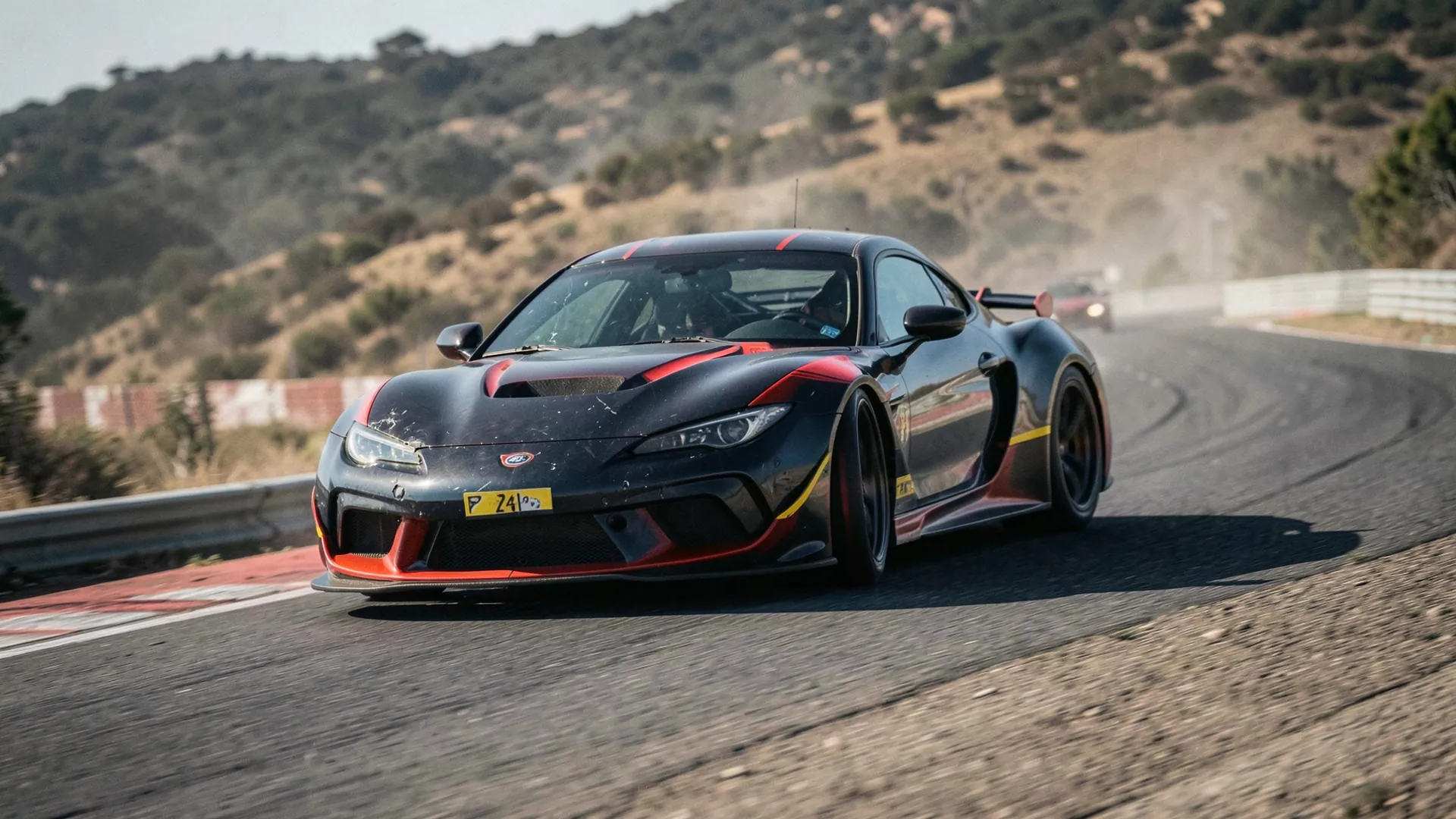
Max Verstappen was penalised by the stewards on Friday after being found responsible for an avoidable collision in the first free practice session of the GT World Challenge Europe Endurance Cup at Portimão. It is an untidy start to his first weekend in the series, coming five days after he won the Singapore Grand Prix from pole. A practice-session sanction is not a scandal. It does, however, sharpen a question Red Bull has so far been content to leave unasked.
A verdict delivered in the wrong kind of traffic
The ruling itself is simple. Verstappen was involved in a collision during FP1, and the stewards concluded that it was avoidable and that he was to blame. GPfans, RacingNews365, Crash.net and PlanetF1 all reported the outcome on Friday. FP1 is the lowest-stakes point of a race weekend to collect such a ruling, and no race result was thrown away.
The setting still matters. Practice in the Endurance Cup is one of the busiest environments in circuit racing. The grid is large and mixes professional drivers with gentlemen racers across several classes. Some drivers are on long runs, some are learning the car, and some are simply trying to stay out of the way. Speed differentials between cars that look identical can be considerable. Portimão adds its own complications, with blind crests, steep changes in elevation and apexes that arrive before a driver can see them.
For a driver whose instincts were formed in single-seaters, that combination is a well-known trap. A GT3 car is heavier and has to brake earlier. Closing speeds on slower traffic are harder to judge, and a gap that would be safe in a Formula 1 car is not always there in a GT car. Many crossover drivers have been caught out the same way. Verstappen’s talent is not in doubt, but his inexperience in this particular kind of traffic is real.
Some perspective is also needed. A ruling from SRO stewards has no bearing on his F1 super licence. Had it counted, there would have been an irony to it: last year Verstappen reached 11 penalty points after his clash with George Russell in Barcelona, one short of a race ban. Those points have since lapsed, and Friday’s verdict adds nothing to his F1 record. The cost is reputational and practical, not regulatory.
Why Red Bull should care about a practice tangle
It would be easy to assume Verstappen is in the middle of a title run-in. The standings say otherwise. Andrea Kimi Antonelli leads the drivers’ championship on 340 points with eight wins. Verstappen, fourth on 221, is 119 behind with six rounds to run. Six Grand Prix wins would be worth 150 points, so Antonelli would have to all but stop scoring for the arithmetic to matter. The title is gone.
That does not make the remaining races meaningless. Two fights are live, and Verstappen sits at the centre of both.
| Fight | Position | Points | Gap |
|---|---|---|---|
| Drivers’ runner-up | 2. George Russell | 238 | Leader of this fight |
| 3. Lewis Hamilton | 229 | 9 behind Russell | |
| 4. Max Verstappen | 221 | 17 behind Russell | |
| 5. Charles Leclerc | 215 | 23 behind Russell | |
| Constructors’ third | 3. McLaren | 339 | Holds third |
| 4. Red Bull | 332 | 7 behind McLaren |
The second fight carries more weight. Constructors’ positions decide prize money, and Red Bull trails McLaren by seven points. Verstappen has scored 221 of the team’s 332 points, roughly two-thirds. Isack Hadjar’s 97 points represent a respectable season, but McLaren can rely on two drivers in Lando Norris and Oscar Piastri. Red Bull, in practice, relies on one. Singapore showed how the arithmetic works: Verstappen’s win and Hadjar’s single point from 22nd on the grid outscored McLaren’s fourth and fifth places by four points.
The worry, then, is less the penalty itself than what the incident says about exposure. A collision in practice can just as easily be a heavy one, and a big impact in a GT3 car can be harder on a driver than its bodywork suggests. An injury, even a minor one, at Portimão this weekend would cost Red Bull far more than any GT result could repay. The United States Grand Prix at the Circuit of the Americas follows on 25 October. Losing Verstappen for one round would almost certainly settle third place in McLaren’s favour.
There is also a quieter cost. By the end of this weekend, Verstappen will have spent a good part of the gap between Singapore and Austin travelling, racing and dealing with stewards in a different championship. Red Bull would not choose that preparation for a driver carrying two-thirds of its points into the final six rounds.
Kubica, Alonso and the price of moonlighting
Formula 1 has seen this tension before, and the precedents point in different directions.
The cautionary tale is Robert Kubica. In February 2011, the Pole crashed heavily on the Ronde di Andora rally in Italy, suffering severe injuries to his right arm and hand. He was Renault’s lead driver and widely regarded as a future world champion. He did not start another Grand Prix until 2019. Teams tightened their contracts after his accident, and clauses restricting dangerous outside activities became standard. Kubica’s crash remains the sport’s shorthand for how a side project can cost a career.
Fernando Alonso is the counter-example. With McLaren’s blessing, he skipped the 2017 Monaco Grand Prix to race in the Indianapolis 500. In 2018 he combined his F1 seat with a full World Endurance Championship campaign for Toyota and won Le Mans in the process. His outside programmes enhanced his reputation and arguably kept him interested during a period when McLaren’s F1 car could not.
The difference between the two is not simply luck. Alonso’s ventures were negotiated, planned around the F1 calendar and run in professional machinery with top-line team-mates. Kubica’s was a one-off entry on a small rally. Verstappen’s GT activities sit much closer to Alonso’s model. He has spent years building his own racing operation and has talked openly about one day racing at Le Mans and in the Nürburgring 24 Hours. Last year’s Nordschleife outings showed he takes the discipline seriously rather than treating it as a novelty.
Red Bull has so far chosen to accommodate those ambitions rather than block them. That is a sensible position with a driver of Verstappen’s stature, and probably the only realistic one. But accommodating a programme is easier when it runs quietly. A stewards’ verdict on the first day of a new series makes it harder to argue that the risk is purely theoretical.
Verstappen’s case for racing everything
The case for letting Verstappen race is strong, and it rests on more than sentiment. He is happiest when he is driving, and he treats sim racing and GT outings as part of the same obsession. Seat time in unfamiliar cars and conditions arguably keeps his instincts sharp. More importantly for Red Bull, it keeps him engaged. A driver who has repeatedly suggested his Formula 1 career will not run indefinitely is more likely to stay if the sport does not feel like a cage. Banning his side projects would carry its own long-term risk.
Friday’s ruling is best read as a reminder of terms, not a reason to tear them up. Verstappen chooses where and how often he races outside F1, and that freedom comes with an obligation to manage his own exposure. In the middle of an F1 season, that means approaching GT practice traffic with the caution of a driver who has more to lose than anyone else on the grid. An avoidable collision is, by definition, one he can choose not to have.
If he leaves the Algarve with nothing worse than the penalty, the episode will be a footnote by the time the cars run in Austin. The more revealing judgement will come over the next six rounds. Red Bull is seven points from third in the constructors’ championship and depends heavily on one driver to close the gap. If Verstappen delivers that, his GT programme will rightly be seen as harmless. If another weekend away goes wrong before the season ends, Red Bull will find it much harder to keep saying yes.