
F1 Returns to Africa as Rwanda Signs 10-Year Grand Prix Deal
Formula 1's first African race since 1993 arrives with a decade-long Rwandan contract, a sound commercial rationale and a proposed circuit layout that needs serious work before ground is broken.
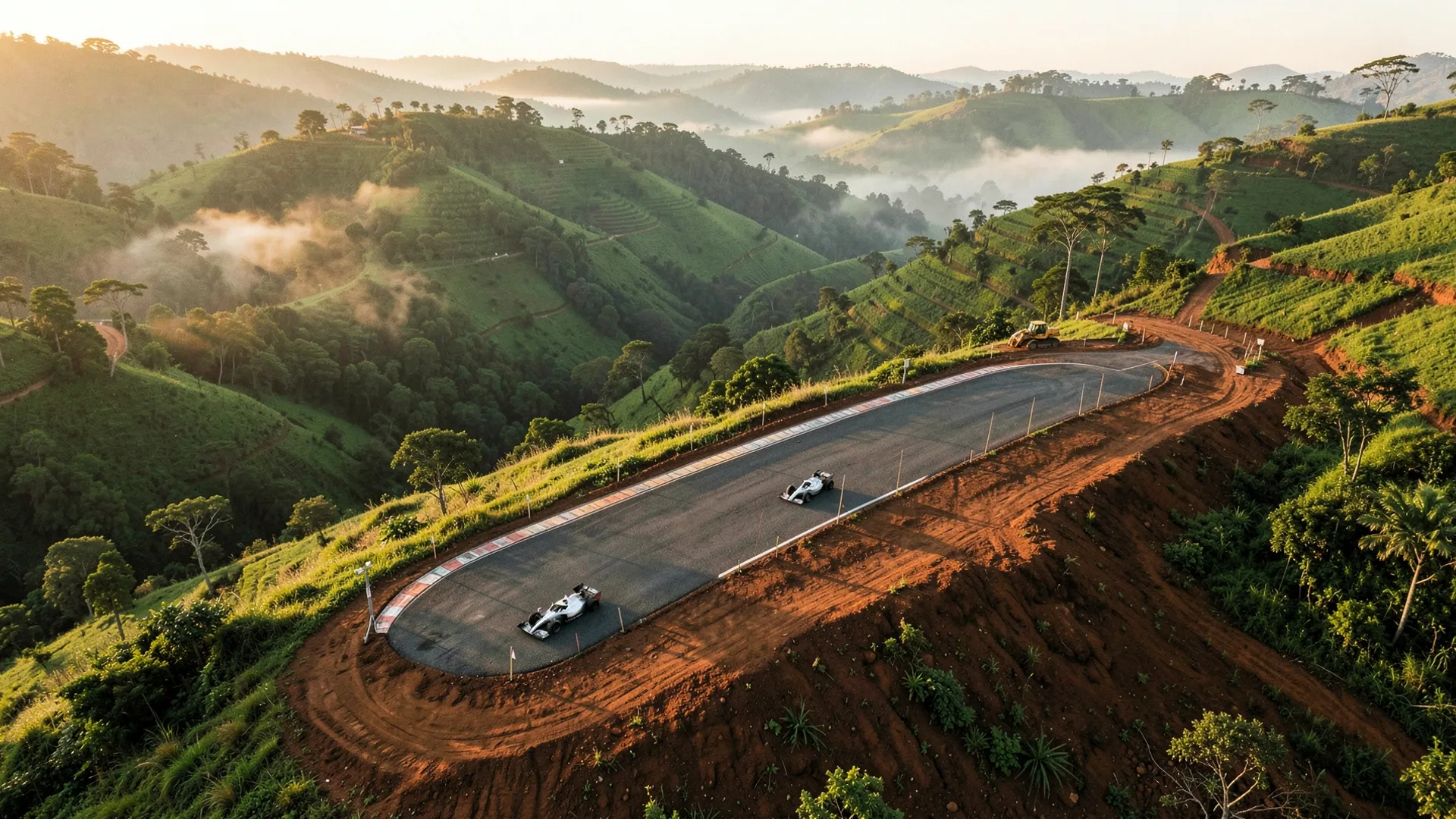
Formula 1 confirmed on Tuesday that it will return to Africa for the first time since 1993, announcing a 10-year agreement to hold a Grand Prix in Rwanda at a new circuit. The deal closes the most conspicuous gap on the world championship map, one the sport has been asked about, with growing impatience, for three decades. The length of the contract shows how seriously both parties are taking it. The early reaction to the proposed layout shows how much is still to be done.
The timing is coincidental, but apt. The announcement came two days after Max Verstappen won in Singapore from pole, a race in which Andrea Kimi Antonelli’s third place and George Russell’s recovery from 19th on the grid to ninth stretched the gap between the Mercedes team-mates to 102 points with six rounds left. The 2026 title is drifting towards a conclusion. The question of what the calendar should look like for the rest of the decade is wide open, and this is the most significant answer to it for some time.
Kyalami, East London and Ain-Diab: Africa’s first chapter
Africa’s world championship history is brief but not slight. Morocco held a single round at Ain-Diab, near Casablanca, in 1958. Mike Hawthorn clinched the title there, and Stuart Lewis-Evans suffered the burns that killed him days later. South Africa then became the continent’s fixture, first at East London, where Graham Hill sealed the 1962 championship after Jim Clark’s Lotus retired from the lead, and later at Kyalami from 1967.
Kyalami’s story cannot be separated from politics. As international opposition to apartheid hardened, the race became harder to justify. In 1985 Renault and Ligier stayed away under pressure from the French government, and the event then fell off the calendar. It returned in 1992, as apartheid was being dismantled, and Nigel Mansell won. A year later Alain Prost won for Williams, ahead of Ayrton Senna. It was the last time a Formula 1 car raced in Africa.
Since then, talk of a revival has surfaced regularly, most often centred on Kyalami, without producing a contract. Funding was usually the sticking point. That history matters, because it explains why Rwanda, a country with no motorsport heritage at this level, has succeeded where South Africa’s established venue repeatedly fell short. Rwanda’s government wanted the race badly enough to pay for it and to commit for 10 years.
A layout that drew fire within hours
The response to the proposed circuit has been hostile. GPfans reported a strong backlash against the layout, and the volume of criticism within hours of the announcement should not be dismissed as reflexive grumbling. Supporters have watched enough new venues arrive in the past 25 years to recognise a pattern, and they do not like what they see.
Their scepticism is grounded in precedent. The purpose-built circuits of the 2000s and 2010s produced a few genuine successes and a longer list of forgettable venues. Valencia’s street circuit and Korea’s Yeongam came and went without leaving much behind. The Buddh circuit in India was well regarded by drivers but did not survive its administrative difficulties. The Circuit of the Americas, where the championship goes next on 25 October, is the counter-example: a greenfield track that borrowed deliberately from proven corners elsewhere, made use of elevation and found a market that has supported it since 2012.
That is the opportunity Rwanda is in danger of wasting. A greenfield site removes every excuse a street circuit can offer. There are no buildings to work around and no existing road network dictating the corner angles. There is no reason the track cannot have a variety of corner speeds, meaningful gradient and run-off designed around racing rather than squeezed into the available space.
There is also a technical argument the designers should heed. The 2026 regulations have changed what a good circuit looks like. With electrical power now a much larger share of the total, layouts with long, uninterrupted full-throttle stretches put heavy demands on energy deployment and can leave drivers managing their batteries rather than racing. A circuit drawn this year, for a contract that runs well into the next decade, should be built for this generation of car rather than the last.
If the drawing published this week is what gets built, the criticism will have been justified. The better reading is that the organisers have been handed a free and very loud consultation exercise before construction begins. Organisers who take that kind of feedback seriously tend to end up with a circuit people want to watch.
Why Rwanda wants Formula 1, and why Formula 1 said yes
The commercial logic on both sides is clear. Rwanda has spent years building a sporting profile out of proportion to its size. Its “Visit Rwanda” tourism branding has appeared on the shirts of Arsenal and Paris Saint-Germain. Kigali hosted the FIA’s annual general assembly and prize-giving in December 2024, when President Paul Kagame publicly set out the country’s ambition to stage a Grand Prix. In 2025 it became the first African country to host cycling’s Road World Championships. Formula 1 is the next step in that strategy, and a 10-year term is the kind of commitment that justifies building a circuit from scratch.
For Formula 1’s owners, Liberty Media, the attraction is partly the fee, which governments are generally willing to pay at a premium. The larger prize is the market. Africa is the youngest continent by population and the one in which the sport has the most room to grow, in both audience and sponsorship. A championship that calls itself a world championship has spent 33 years absent from a continent of more than a billion people. That was always an awkward position to defend.
The commercial case is not the only one that will be examined. Rwanda’s government has faced sustained criticism over political freedoms at home, and United Nations experts have reported on Rwandan backing for the M23 rebel group in the neighbouring Democratic Republic of Congo. Formula 1 has heard similar arguments over Bahrain and Saudi Arabia, and its standard response is that engagement does more good than absence. That argument deserves to be tested rather than accepted on trust. Fans and drivers are entitled to ask what that engagement amounts to in practice.
Lewis Hamilton, third in the standings and 111 points behind Antonelli, has argued for years that the sport cannot call itself global without a race in Africa, and he has paired that with calls for it to think harder about where it goes and why. Both halves of that position apply here.
Fitting Rwanda into a 24-race ceiling
There is also a calendar to fit the race into. This season runs to 23 rounds, against the ceiling of 24 permitted under the Concorde Agreement, so adding Rwanda would take the schedule to the limit. Either another event rotates out in some years or the calendar settles permanently at the maximum, a prospect the teams’ travelling staff will greet with little enthusiasm. Where the race sits matters too. Paired sensibly with nearby flyaways, it could cut freight miles. Dropped awkwardly into the year, it will add to them.
The 10-year term is the most important detail of the announcement. Short contracts produce short-term thinking, with promoters chasing the first year’s spectacle and little reason to invest in what happens afterwards. A decade gives Rwanda time to build a local audience and a motorsport culture that does not yet exist, and to refine the event year on year. It also removes any excuse if it fails to do so.
Returning to Africa is the right decision, and it is long overdue. Whether Rwanda proves a lasting addition will depend on a decision taken well before the first car turns a wheel: whether the organisers redraw the circuit in response to this week’s criticism. If they do, the race can follow the path of Austin, a new venue that built its own following. If they build what they have shown, it risks following Yeongam, an expensive circuit that left the calendar with little to show for it.