
Pit stops and race strategy: how races are won off the track
A two-second pit stop, an undercut, a safety car gamble — how F1 races are decided by strategy as much as speed.
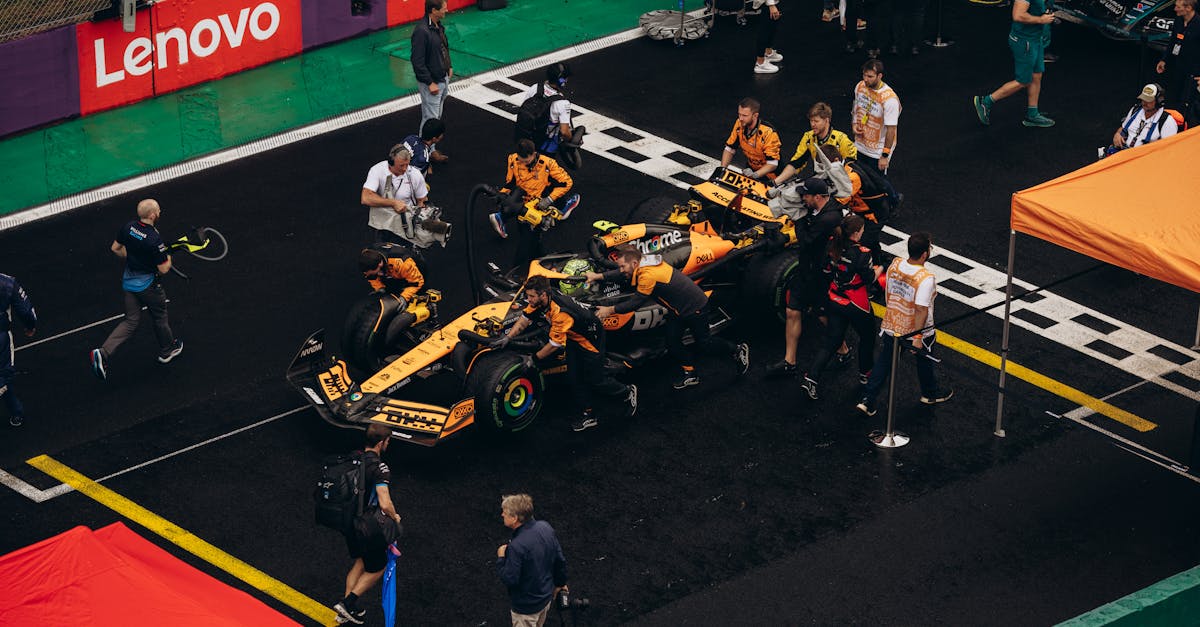
The fastest car on a given afternoon does not always take the chequered flag. Formula 1 is unusual among sports in that a huge slice of the contest happens away from the racing itself — in a stall barely wider than the car, and in a bank of laptops on the pit wall where engineers quietly re-plan the race a dozen times an hour. A driver can qualify on pole, drive faultlessly, and still lose because a rival’s crew was half a second quicker on a tyre change, or because a strategist made a braver call about when to stop.
This is the part of a Grand Prix that first-time viewers rarely notice and lifelong fans obsess over. Once you can read it, the long middle stretch of a race — the bit that looks like cars driving round in circles — turns into the most gripping chess match in sport. Here is how the off-track game actually works.
The two-second miracle
A modern F1 pit stop replaces all four wheels in roughly two to three seconds. The world-record stops have dipped under two seconds — barely enough time to blink twice. Refuelling has been banned for years, so a stop is now purely about tyres (plus the occasional front-wing change or nose replacement after contact). That ban is exactly why stops got so fast: without a fuel hose dictating the timing, the only limit is how quickly humans can wield a wheel gun.
Pulling it off takes a choreographed crew of around 18 to 20 people, each with one narrowly defined job:
- Three per wheel (twelve in total) — one to work the wheel gun that undoes and retightens the single central nut, one to rip the old wheel off, one to ram the new wheel on.
- Two “front jack” and “rear jack” operators who lift the car the instant it stops and drop it the moment the wheels are on.
- Steadiers on each side who hold the car level so it doesn’t rock while it’s in the air.
- A “lollipop” or light system operator who tells the driver to brake, hold, and — critically — go.
- Spare hands ready with a front-wing adjuster or a replacement nose.
The margins are brutal. A wheel gun that cross-threads a nut, or a wheel that isn’t fully seated, can cost anything from a couple of seconds to a full pit-lane visit’s worth of time. A stop that should have been 2.4 seconds becoming 6 seconds does not sound like much — until you realise it can drop a driver from second to sixth, behind cars they may not be able to re-pass all afternoon. Crews rehearse the sequence thousands of times a season, in the dark, in the wet, with deliberate faults thrown in, precisely because the difference between a good stop and a disaster is measured in tenths.
Pit-lane rules
The pit lane is one of the most tightly policed places on the circuit, because it is full of standing personnel and cars arriving at speed.
- The pit-lane speed limit is typically 80 km/h, sometimes 60 km/h on tighter layouts. Cars engage a pit limiter — a button that electronically caps their speed — and exceeding it brings an automatic time penalty. Crawl too cautiously, though, and you simply lose time you’ll never get back.
- The box is the team’s marked stall. The driver must stop with the wheels bang on their marks so the crew can reach every corner; overshooting by even half a metre forces the mechanics to shuffle and adds precious tenths.
- Unsafe release is the cardinal sin. If a car is released into the path of another, or with a wheel not properly attached, the stewards hand out a penalty — and if a loose wheel is involved, the consequences can be severe. This is why you sometimes see a mechanic physically block a driver from leaving.
- Penalties served in the pits include the five- and ten-second penalty (added at the next stop or to the final time) and the drive-through and stop-go, where the driver must come down the pit lane, or stop in the box for a set time, gaining nothing.
- A team can also elect to start from the pit lane — usually after breaking parc fermé rules to change the car’s setup overnight. The driver forfeits their grid slot and starts behind the field once it has passed, but gains a freshly optimised car and, sometimes, a strategic free hand.
Why track position is gold
Here is the single idea that unlocks all F1 strategy: passing on track is genuinely difficult, so a position gained in the pits is often worth more than one you’d have to fight for on the circuit.
The reason is aerodynamics. An F1 car generates enormous grip from the airflow over its bodywork, but that airflow is thrown into turbulent chaos behind the car — the infamous “dirty air.” A car trying to follow closely loses downforce, its tyres overheat and slide, and it struggles to stay close enough through the corners to attack on the straight. Even with the 2026 Manual Override system — the electric power boost handed to a chasing driver, which replaced the old DRS rear-wing flap — closing the final few car lengths remains hard work.
So teams reach for the pit lane as an overtaking tool. If you can’t get past a rival wheel-to-wheel, you try to leapfrog them during the stops instead. That is where the undercut and overcut come in. For a fuller tour of the on-track side of this — grids, flags, points and more — see our guide to how Formula 1 works.
Tyre strategy fundamentals
Every dry Grand Prix runs under one deceptively powerful regulation: a driver must use at least two different slick compounds during the race. You cannot simply bolt on your best tyre and drive to the flag — the rules force at least one pit stop, and therefore force a strategic decision.
The tyres come in a range of compounds from soft to hard. Softer rubber is faster but wears out sooner; harder rubber is slower but lasts. Everything flows from a single villain: degradation — the gradual loss of grip and lap time as a tyre wears and overheats over a stint (the run of laps between stops). A soft tyre might be half a second a lap quicker when fresh but “fall off a cliff” after fifteen laps; a hard tyre might never be that fast but hold steady for forty.
Strategists plan the race as a set of stints that add up to the full distance, balancing raw pace against how long each tyre will survive on that particular track surface and temperature. Get the stint lengths right and you’re always on the quickest rubber available; get them wrong and you’re a sitting duck on dead tyres while faster cars close in. If you want the compounds and their coloured sidewalls explained properly, our F1 tyres guide breaks it all down.
The undercut and the overcut
These are the two classic weapons of pit strategy, and they are mirror images of each other.
- The undercut — you pit first, while your rival stays out. Your fresh tyres are dramatically faster than their worn ones, so you bang in one or two blistering laps. When the rival finally pits a lap or two later, they rejoin behind you, having lost more time on old rubber than you lost in the pit lane.
- The overcut — you stay out longer than a rival who has already stopped. If their new tyres take a lap or two to warm up, or if they hit traffic, you can use clear track to lap quickly on your older-but-warm tyres, then pit and rejoin ahead.
Here is a simplified worked example to show how track position flips:
Two cars are nose-to-tail, Car A leading Car B by one second. Car B pits first for fresh tyres. On its out-lap, Car B is a full 1.5 seconds a lap quicker than Car A, who is nursing worn rubber. Car A responds by pitting the very next lap — but in those laps, Car B has already erased the deficit and banked a cushion. When Car A rejoins from its own stop, Car B sails past the pit exit ahead. One well-timed lap in the pits achieved what might have taken twenty laps of frustrated chasing on track — or never happened at all.
Which weapon works depends on how much the fresh tyre actually gains (“delta”), how warm the new tyres come in, where the traffic is, and how long the pit lane itself is. Guess right and you win the position for free. Guess wrong — undercutting into traffic, or overcutting on tyres that have nothing left — and you hand it straight back.
The safety car and VSC gamble
Every strategist keeps one eye on the possibility of a caution period, because it is the single biggest free lunch in racing.
When a crash or hazard brings out the Safety Car, the entire field bunches up and slows to a crawl behind it. Under a Virtual Safety Car (VSC), cars aren’t physically gathered but must all slow to a mandated delta. In both cases the crucial point is the same: because the whole field is moving slowly, the time lost by diving into the pits shrinks dramatically.
Think of it this way. Normally, a pit stop costs you perhaps 20-plus seconds relative to a car staying out at full racing speed. But when everyone is trundling round at half pace, the gap between “in the pits” and “on track” narrows to a fraction of that. A stop that would usually cost you a place or two can suddenly cost almost nothing — a “cheap” or even “free” pit stop. Teams that pit at the right moment can gain multiple positions without touching another car.
The catch is timing. Cautions are unpredictable, and there is a cruel version of the same coin: if you have just pitted at full racing cost and a safety car comes out on the very next lap, your rivals all get their cheap stops and jump you. Equally, dithering for even one lap — or being caught in a queue as the pit lane closes — can turn a golden opportunity into a lost race. This is why you’ll hear a strategist bark an instant “box, box, box” the moment the caution flashes up.
Weather gambles
Rain turns strategy into a high-stakes guessing game, because it forces a choice between three very different tyres: slicks for a dry track, intermediates for damp conditions, and full wets for standing water.
The decisive moment is the crossover — the point at which the track is drying (or wetting) enough that the other tyre becomes faster. On a drying track, intermediates are quicker while there’s moisture, but as a dry line appears they overheat and grain; at some invisible tipping point, slicks become several seconds a lap faster. Pit for slicks a lap too early and you’ll be sliding helplessly on a wet track, potentially into the barriers. Pit a lap too late and rivals who gambled earlier will have leapt you.
The best strategists read radar, watch the sky, and — crucially — listen to their driver’s feedback about where the track is greasy. Fortunes swing wildly in these conditions precisely because there is no safe answer: standing still is a decision, and the “right” call only becomes obvious in hindsight.
One-stop vs two-stop
The most fundamental strategic question of a dry race is simply how many times to stop, and the maths behind it is more subtle than it looks. It comes down to a tug-of-war between two numbers:
- Pit loss — the total time surrendered by making a stop (pit-lane travel at the speed limit, plus the stop itself). Call it, for illustration, around 22 seconds.
- Tyre pace — how much lap time you gain by running fresher, faster tyres more often.
A one-stop strategy makes fewer trips down the pit lane (less pit loss) but forces longer stints on ageing, slower tyres. A two-stop pays an extra pit loss but rewards you with fresher, quicker rubber throughout. The faster strategy is whichever wins that trade — and it changes race to race with the track’s abrasiveness, tyre degradation and air temperature.
| Time in pits | Tyre condition | Best when… | |
|---|---|---|---|
| One-stop | Lower (one stop) | Older, slower tyres | Low degradation; overtaking hard; hot on tyres you’d have to nurse |
| Two-stop | Higher (two stops) | Fresher, faster tyres | High degradation; a long pit-lane isn’t punishing; you can pass |
The reason the “obvious” answer is so often wrong is that the sums assume clear track. In reality, an extra stop can drop you into a DRS-less train of traffic — remember, on-track passing is hard — where you can’t use your fresh-tyre pace at all. A theoretically slower one-stop that keeps you in clean air can beat a faster two-stop that buries you behind slower cars. This is the argument that plays out on the pit wall every single Sunday.
The pit wall
Behind every driver sits a small army of strategists, usually split between the trackside pit wall and a remote operations room back at the factory. Their job is to model the race live: feeding tyre-wear data, fuel loads, gaps to rivals, weather radar and rivals’ likely plans into simulations that spit out lap-by-lap probabilities of each strategy winning.
Crucially, they don’t run one plan — they run several in parallel. “Plan A” is the pre-race intention; “Plan B” (and C, and D) are the branches they switch to when a safety car falls, a rival undercuts, or the tyres degrade faster than expected. When you hear the pit wall tell a driver “we’re going to Plan B,” that’s the strategists reacting in real time, having already war-gamed the scenario.
All of this reaches the driver through the radio — terse, coded, deliberately calm. “Box this lap,” “target plus-two,” “he’s in the pits, push now.” The driver, meanwhile, is feeding back what the strategists can’t see from the data: how the tyres feel, where the grip is, whether they can attack or need to defend. The best results come from that loop working seamlessly under pressure. If some of the jargon still trips you up, our F1 glossary decodes the shorthand you’ll hear on team radio.
Frequently asked questions
Why don’t F1 cars refuel during pit stops anymore?
Refuelling was banned years ago, primarily for safety and cost reasons. Cars now start with all their fuel on board, which is why they’re heaviest — and slowest — at the start of a race and get quicker as the fuel burns off. It also means pit stops are purely about tyres, which is what made them so blisteringly fast.
How long does a “normal” pit stop cost a driver?
The physical stop is two to three seconds, but the relevant figure is the total pit loss — the time lost versus staying on track, including the slow drive down the speed-limited pit lane. That’s typically around 20 seconds or more, and it varies enormously by circuit: a long pit lane punishes stops heavily, which pushes teams towards one-stop strategies.
What’s the difference between an undercut and an overcut?
An undercut means pitting earlier than a rival to exploit fresh-tyre pace and jump them. An overcut means staying out longer to lap quickly in clear air while their new tyres warm up, then pitting and emerging ahead. Both aim to gain a position in the pits rather than risk a difficult on-track pass.
Why is overtaking on track so hard in F1?
Following closely wrecks a car’s aerodynamics — the dirty air off the car ahead robs the chaser of downforce and overheats its tyres. The 2026 Manual Override electric boost (which replaced DRS) helps the chasing car on the straights, but closing and completing a pass is still tough. That difficulty is the whole reason pit strategy matters so much.
Is a one-stop always faster than a two-stop?
No — it depends entirely on the trade between pit loss and tyre pace at that particular track, plus the traffic you’d rejoin into. High tyre degradation favours more stops; low degradation and hard-to-pass circuits favour fewer. The genuinely fastest strategy is often not obvious until the race unfolds.
The bottom line
Once you understand strategy, a “boring” race transforms in front of your eyes. That gap quietly opening up between two cars? It might be an undercut being set up. That driver stubbornly staying out on visibly worn tyres? A gamble that a safety car is coming. That sudden three-place gain with no overtake in sight? A cheap stop under caution, executed to the second. The most decisive contest in Formula 1 is frequently the one you can’t see at all — until you know where to look. Now you do.